Quick Answer: Is UVC Light in an Air Purifier Safe?
Yes, UVC light in an air purifier is safe for daily use if it is a fully enclosed system engineered for occupied spaces.
It is crucial to distinguish between dangerous “open” UV robots (which require empty rooms) and enclosed air sterilization systems. Safe commercial units, like Germitrol, house high-intensity UVC lamps entirely within an internal, shielded metal reaction chamber.
This engineering ensures that no harmful UV radiation escapes the unit, making it safe for employees to work beside 24/7. Additionally, high-quality systems use specific 254 nm lamps that are ozone-free and include automatic safety cut-off switches to prevent accidental exposure during maintenance.
If you are upgrading your office hygiene, the first question on your mind is likely: is UVC light in air purifier safe? It’s a valid concern. If you search online, you will find warnings about skin burns and eye damage because UVC radiation is powerful stuff. However, it is exactly that power that makes it so effective at destroying viruses and mold.
If you search for “UVC light safety,” you will likely find warnings about skin burns and eye damage. It’s a valid concern—UVC radiation is powerful stuff. It is exactly that power that makes it so effective at destroying viruses and mold.
But this leads to a common question from Facility Managers and HR Directors: “If I put a UVC air purifier in my Singapore office, am I putting my staff at risk?”
The answer lies in the engineering. There is a massive difference between “open” UV sources and enclosed Air Sterilization Systems. Here is why a properly engineered unit (like the Germitrol system) is safer than your office microwave.
1. The Critical Distinction: Exposed vs. Enclosed
The danger of UVC comes from direct exposure.
- Open Systems (Robots & Wands): You may have seen UV robots used in hospitals or airports. These blast UVC light in all directions. They are effective, but they are dangerous—the room must be empty of humans during operation.
- Enclosed Systems (Germitrol): Our units are designed for Occupied Space Sterilization. The high-intensity UVC lamps are completely housed inside a UVC chamber.
Think of it like a microwave oven. A microwave uses radiation to cook food, but because the radiation is contained inside a shielded metal box, you can stand right next to it safely. Germitrol units work on the same principle: The “Kill Zone” is strictly internal. No UV light escapes the unit.
2. The Ozone Myth: Not All UV is the Same
Another common safety fear is Ozone. Some lower-grade UV devices (often sold online for home use) emit light at a wavelength of 185 nanometers (nm). This creates ozone, a gas that can irritate the lungs and smells like “sparking” electricity.
We do not use ozone-generating lamps. Germitrol utilizes specific 254 nm Germicidal UVC.
- This specific wavelength is the “sweet spot” for breaking down DNA and RNA in bacteria and viruses.
- It does not generate ozone.
- This means the air coming out of the machine is clean and odorless, with zero respiratory irritants added.
3. Material Matters: Why Plastic Fails
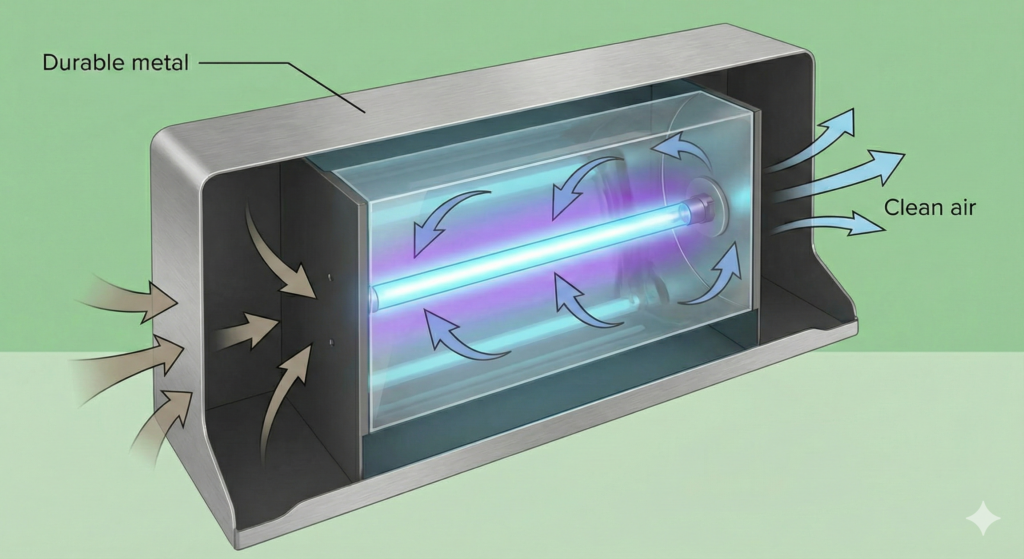
Safety isn’t just about the light; it’s about the machine itself. UVC light is destructive—it breaks down organic bonds. If you put a powerful UVC lamp inside a cheap plastic air purifier, the UV light will eventually degrade the plastic casing, causing it to become brittle and crack, potentially leaking UV light or fumes.
This is why Germitrol units are engineered with specialized UV-resistant chambers, available in either treated high-grade polymer or durable metal housings. Metal is impervious to UVC degradation. It ensures that the unit remains a fully sealed “black box” for the entire lifespan of the product, ensuring zero UV leakage.
4. Safety Switches: The Fail-Safe
We design for the “what ifs.” What if a curious employee tries to open the maintenance door while the unit is running?
Every Germitrol unit is equipped with safety cut-off switches. The moment the access door is unlatched, the electrical circuit to the UV lamps is physically broken. The lights turn off instantly—before the door can even be fully opened. There is literally no way to accidentally expose yourself to the light.
5. The Payoff: 24/7 Protection
Because our system is completely safe for human proximity, it offers a huge advantage over those “robot” cleaners: Continuous Operation.
You don’t have to wait until the office is empty to clean the air. Germitrol units quietly sterilize the air while your team is working, eating, and breathing. This prevents cross-contamination in real-time, catching that flu virus before it travels from the Sales team to the Finance department.
Conclusion: So, Is UVC Light in Air Purifier Safe?
Is UVC safe? In the wrong hands, no. But inside a Germitrol unit, it is the safest, most effective tool you have for Indoor Air Quality.
We have harnessed the power of the sun and put it in a box, so you can breathe easier without worrying about safety.