
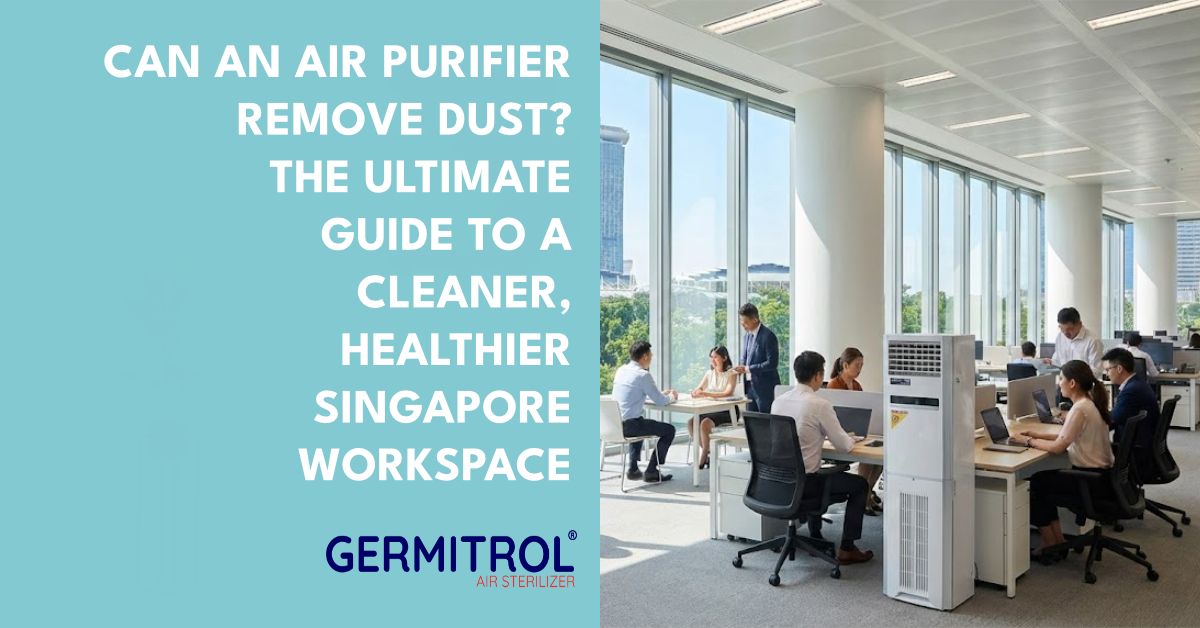
Walk into any office in the CBD, a library in Jurong, or a classroom in Tampines, and you’ll likely see the same silent enemy: a thin, grey film settling on computer monitors and bookshelves.
In Singapore’s humid, urban environment, dust isn’t just “dirt.” It is a complex cocktail of skin cells, fabric fibers, outdoor soot from traffic, and microscopic debris. If you’ve ever wiped down a desk only to find it dusty again 24 hours later, .you’ve probably asked: does an air purifier remove dust, or am I just fighting a losing battle?
The answer is a resounding yes—but with a major caveat. Not all purifiers are created equal. To truly win the war on dust and the germs it carries, you need more than a retail-grade fan; you need a system designed for sterilization.
Quick Answer: Yes, an air purifier does remove dust. High-quality air purifiers equipped with True HEPA filters are designed to physically trap airborne dust particles, lint, and dander. However, to effectively clear heavy dust in commercial spaces or offices, the unit must have sufficient airflow (CADR) and the correct placement to prevent the dust from settling on surfaces.
1. Understanding the Enemy: What is dust?
Before we look at how to remove it, we have to understand what we are catching. Dust in a Singaporean commercial space is unique. Because of our high humidity and density, dust acts as a “vessel.”
- Particulate Matter (PM2.5): These tiny particles from industrial activities and vehicles often drift indoors.
- Organic Matter: Skin cells and hair fibers from staff and visitors.
- The “Hitchhikers”: This is the dangerous part. Dust particles are essentially public transport for bacteria, mold spores, and viruses. When dust settles, the germs settle with it.
When you ask, “does an air purifier remove dust?” you aren’t just asking for a cleaner desk; you are asking for a healthier breathing zone.
2. The Science of Trapping Dust: HEPA vs. The Rest
If you want to remove dust, the filter is your front-line soldier. To effectively clear the air, a unit must use a HEPA (High-Efficiency Particulate Air) filter.
How HEPA Works A true medical-grade HEPA filter is designed to capture 99.97% of particles as small as 0.3 microns. To give you some perspective:
- Visible Dust: 10 to 50 microns.
- Human Hair: 50 to 70 microns.
- Bacteria: 0.3 to 5 microns.
Because visible dust is “huge” compared to the fibers in a HEPA filter, it gets trapped almost instantly. However, cheap “HEPA-type” or “HEPA-like” filters often have gaps large enough for fine dust and soot to pass right back out into the room. This is why many people feel their air purifiers don’t work—they are simply filtering the large chunks and letting the fine, irritating dust recirculate.
3. The Myth of “High Speed”: Why Dwell Time Matters
This is where many businesses make a mistake. They assume that a powerful, noisy fan blasting air at high speed is the best way to clean a room.
At Germitrol, we take a different approach. While standard purifiers rely on brute force to circulate air, we prioritize “Dwell Time.”
Effective air purification isn’t just about moving air; it’s about treating it.
- The Problem with High Speed: If air is forced through a machine too quickly, it creates turbulence and noise, but more importantly, it rushes pathogens past the internal mechanisms too fast to be effectively neutralized.
- The Power of Controlled Flow: We utilize a steady, controlled airflow. This ensures that as dust is drawn into the unit, the air lingers inside the sterilization chamber for the precise amount of time needed.
This controlled pace serves a dual purpose: it effectively draws in ambient dust without creating disruptive drafts, and crucially, it sets the stage for our core technology: UV Sterilization.
4. The Germitrol Difference: Don’t Just Trap, Sterilize

This is where the “slow and steady” airflow pays off. While a standard HEPA filter answers the question “does an air purifier remove dust?”, it creates a new problem: a “hot” filter.
When a filter traps dust, it is also trapping all the bacteria and viruses attached to that dust. Over time, in Singapore’s humidity, a clogged filter can become a breeding ground for mold and colonies of germs.
Our Solution: UVC Integration Germitrol units (like the Germitrol 520) combine HEPA filtration with high-intensity UVC Sterilization. This is why our controlled airflow is vital:
- The Capture: The HEPA filter traps the dust.
- The Kill Zone: Because the air flows through the machine at a calculated pace (rather than being blasted through), the internal UVC lamps have enough residency time to blast the trapped particles with germicidal light.
- The Result: This neutralizes pathogens, ensuring that when your maintenance team eventually changes the filter, they aren’t handling a biohazard.
5. Strategic Placement: Where to Put Your Unit for Max Dust Capture
Since we aren’t relying on a “tornado” of high-speed air, placement becomes strategic. To see a visible reduction in dust on your surfaces:
- Avoid the Corners: Dust accumulates where air is stagnant. Placing a unit in a tight corner limits its ability to pull air from the center of the room.
- The “Breathing Zone”: Place units at a height or position where they can intercept air as it moves between people.
- High-Traffic Areas: Entrances and hallways are “dust highways.” Catching the dust there prevents it from spreading to sensitive areas like server rooms or executive offices.
6. How to Fix a Constantly Dusty Room in Singapore
If you have one specific room that is always dusty, it’s often due to a combination of high foot traffic and poor ventilation. To clear a dusty room quickly, place your UV air purifier in the center of the “breathing zone” rather than a corner. For Singapore offices, we recommend a unit with a high CADR (Clean Air Delivery Rate) to ensure the air is cycled and sterilized every 12-15 minutes.
7. The ROI of Dust Removal
Why should a Singapore business care about dust? It’s not just about aesthetics.
- Electronics Longevity: Dust is the #1 killer of office hardware. It clogs fans and causes overheating in laptops and servers.
- Employee Health: Dust is a major trigger for asthma and “Sick Building Syndrome.” Clearer air means fewer “sneezing fits” and higher productivity.
- Cleaning Costs: Effective air sterilization reduces the frequency of deep-cleaning services for carpets and upholstery.
8. Conclusion: The Final Verdict
Does an air purifier remove dust? Yes. But if you want to stop the cycle of endless wiping and sneezing, you need a system that thinks beyond just a fan and a filter.
You need a system that values precision over speed. By combining medical-grade HEPA filtration with the dwell time required for effective UVC sterilization, you don’t just move dust around—you capture it, kill the germs attached to it, and breathe easier.
Request Your Sizing Consultationhttps://www.germitrol.com/contact.html
Explore Germitrol UVC & HEPA Solutions https://www.germitrol.com/products.html
Or reach out directly: [email protected]